








Audio analysisMix translationLUFS and true peakRelease readiness

Audio Analysis Software for Producers and Engineers.

Marisonus helps you analyze loudness, true peak, clarity, low-end balance, mix translation, and release readiness before you export.

It is built for the real workflow: upload a track, review the mix analysis quickly, compare versions, and decide what to fix next without digging through a wall of isolated metrics.

Start your workspace
01

Upload your track for audio analysis

Drop in a sketch, mix, soundtrack cue, or near-final master for a fast read on loudness, balance, and release readiness.

02

Review loudness, clarity, and translation

See what is already working, what slipped since the last version, and which mix issues deserve attention first.

03

Fix the next mix decision with intent

Turn the readout into one focused next move before the next bounce, client send, mastering pass, or release export.

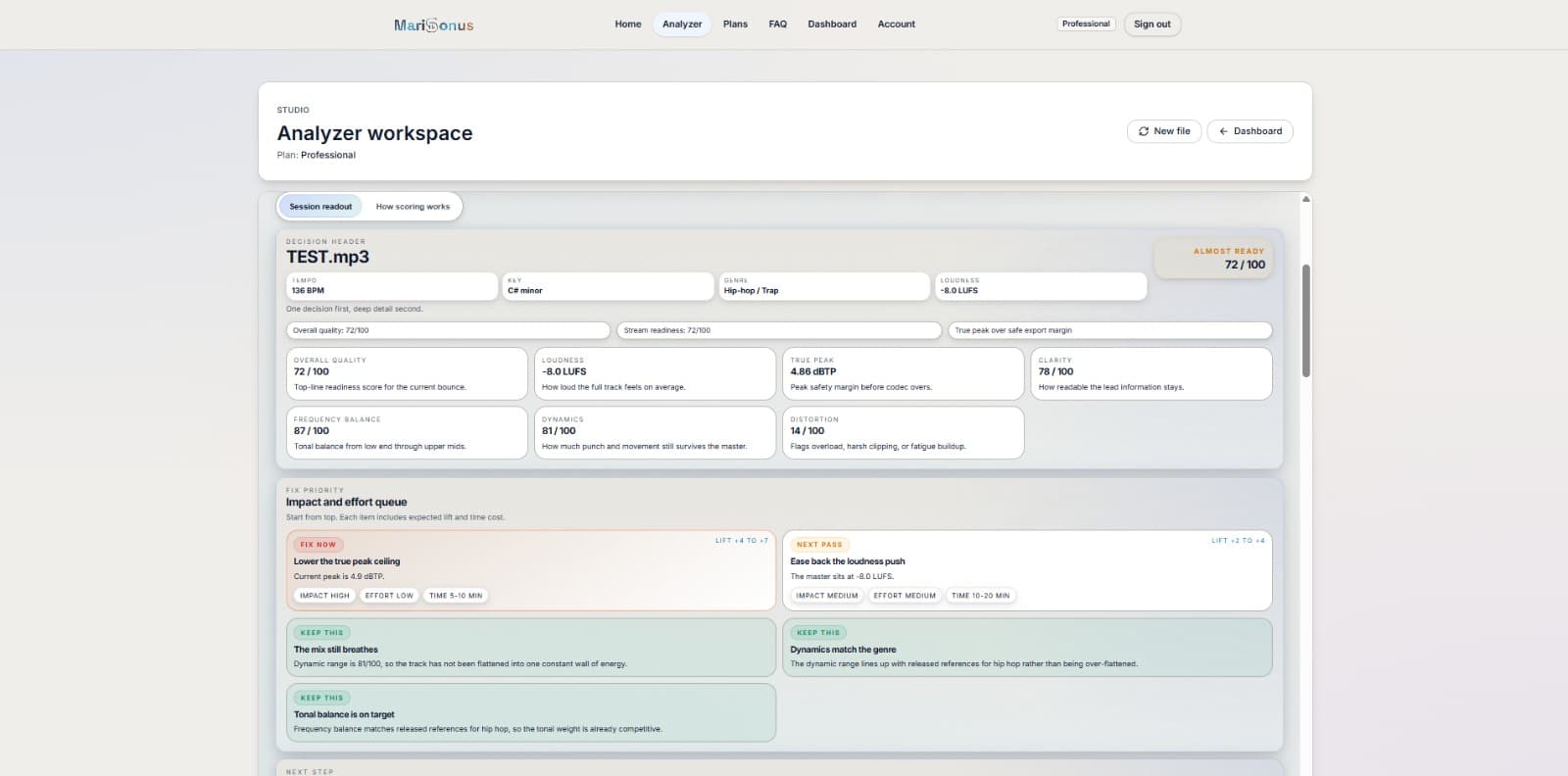
Example audio analysis report for mix and release decisions

Mix analysisVersion compareActionable fixes

Not a wall of measurements. A compact audio analysis report for pre-export decisions: instant signal on LUFS, true peak, clipping risk, low-end balance, clarity, streaming readiness, what changed, and what to tighten before the next bounce.

Tempo
128 BPM
Genre
progressive house
Key
E minor
True peak
-1.2 dBTP

Overall quality

88 / 100
Excellent

Release-ready with strong translation across platforms and minimal technical concerns.

Stream readiness

94 / 100
Ready

Translates safely through loudness normalization and peak limits on all platforms.

Clarity

86 / 100
Strong

Lead elements stay readable with excellent definition across playback contexts.

Frequency balance

84 / 100
Balanced

Low-end is stable and well-separated with excellent kick-to-bass definition.

Loudness

-9.8 LUFS
Safe

Sits safely in the competitive range with headroom for platform normalization.

Verdict

✓ Ready for Release

This mix is in excellent shape and ready for delivery. Minor optional: consider a touch more presence in the 3-4k range if seeking maximum vocal clarity on consumer earbuds, but current state translates safely across all platforms.

Low-end stability

Kick and bass are well-separated with excellent mono compatibility. Low-end translation will remain solid across playback systems.

Translation quality

Mix translates very safely across all major playback contexts with minimal platform-specific degradation.

Audio analysis context

Reference-aware

Your track is evaluated in musical context, so the mix analysis feels closer to a real release benchmark than a generic meter.

Mix review speed

Fast decisions

Move from upload to loudness, clarity, and balance decisions quickly without digging through disconnected measurements.

Actionable feedback

Clear next moves

Beyond scores, Marisonus highlights what sounds strong, what may block translation, and what to fix before export.

Why Marisonus works better than a basic loudness checker

It combines audio analysis, mix translation insight, and practical next steps in one release-focused workflow.

Marisonus helps you hear when a record already feels expensive, when the chorus is not opening enough, when the vocal pocket is getting masked, or when the low end is swallowing the rest of the arrangement.

Generic analyzers stop at measurements. Marisonus adds context, mix analysis, version-to-version movement, and a clear next action you can use immediately before release.

Mix translation check

Catch tonal crowding, vocal masking, stereo drift, and low-end problems before export.

Release readiness review

Read whether the track lands controlled, flat, too dense, or commercially ready across key playback systems.

Actionable mix feedback

Know what is already working and what to fix next so revisions stay focused instead of endless.

What Marisonus analyzes

One workflow for loudness, true peak, low-end balance, stereo width, and mix translation.

The goal is not to replace taste. The goal is to make technical and musical mix decisions easier to see before mastering, release upload, or client delivery.

Loudness and true peak analysis

Check integrated loudness, true peak, clipping risk, and streaming readiness before final export.

Mix translation and playback risk

Understand how the track may behave on earbuds, laptop speakers, cars, and club playback.

Low-end balance and muddiness

Catch muddy low mids, sub instability, and kick-to-bass collisions before they become mastering problems.

Clarity, width, and stereo stability

Review vocal readability, stereo width, and whether the mix stays stable without phase problems.

Dynamics and release energy

See whether the track feels controlled, flat, dense, or convincingly release-ready across key sections.

Version-aware mix decisions

Compare one bounce against another so revisions improve the record instead of just moving it sideways.

Who it is for

Built for producers, mix engineers, mastering engineers, and soundtrack composers.

Marisonus is most useful when you need a faster answer to questions like: Is the mix release-ready? Is the low end muddy? Is the master too hot? Will this translate on real playback systems?

For producers

Use Marisonus to check whether the mix is translating, the low end is stable, and the next bounce is moving in the right direction.

For mix engineers

Spot clipping risk, vocal masking, stereo issues, and clarity problems before sending revisions to the client.

For mastering engineers

Review loudness, true peak, dynamics, and mix balance before committing the final master to platform delivery.

For soundtrack and cinematic work

Check whether a cue opens up enough, stays readable, and keeps dynamic shape without turning flat or harsh.